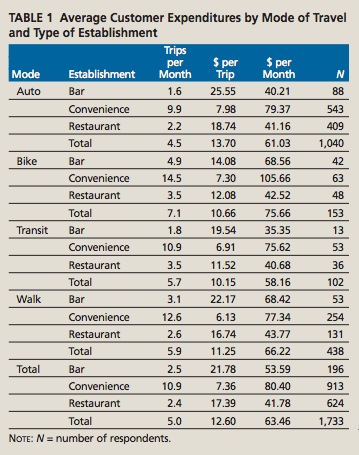
People who go to the bar by bicycle spend more overall, but look like cheapskates.
That and other economic lessons can be gleaned from the preliminary results of a research team at Portland State University (funded by the same folks who recently discovered that less driving doesn’t hurt the economy). The bulk of the paper (download the PDF here) is an excellent economic overview on the existing research on the economic impacts of bicycling in the US.
The part that jumped out at me, though, was in a sidebar (at left) showing preliminary results from a study comparing spending with transportation mode in the Portland area.
If you look closely, you’ll notice that people who walk and bicycle to bars spend less each visit … but they visit more. People who arrive at bars by bike spend the least, an average of $14 a trip. Bar patrons arriving by other modes spend more, suggesting that they’re getting dinner along with their drinks. People who go to bars by bicycle sure look like cheapskates — until you notice that they tend to go to the bar, on average, far more than people using other modes.
The other big difference that pops out is the amount and frequency of spending at convenience stores. People who bicycle to these stores go there more frequently and spend more each time than people who use any other mode, spending on average $25 more per month. This baffled me until I remembered the primary product of these establishments: Beer.
This connection between bicycling and beer makes gut sense. This is Portland, where craft breweries and distilleries are a thriving industry. And if the city’s diverse array of bike cultures have anything in common, it’s enjoyment of these establishments and their products.
I’m speculating — though it’s speculation based on some serious participant-observation — that much of this drinking, even of convenience-store beer, isn’t of the binge variety. Bicycling means you have more disposable income, and I’ve seen many an underemployed person spend upwards of $6 on a delicious locally brewed pint rather than economizing to consume more, nastier beer for less. Which would mean in turn, that much of that extra spending is going directly back into the local economy.
It also would mean that these folks are riding home from the bar in a straighter line than you might think after looking at these numbers. Which is a relief. Be safe out there while you’re boosting the economy, y’all.
Update: I ran some of this by Kelly Clifton, the lead researcher on the study, and while she didn’t want to speculate on green dividends and disposable income, she did have this insight:
“I think the upshot is that cyclists (and peds and transit users) are competitive consumers. I think one of the reasons that autos spend more at bars is that those dollars might include more people (kids, for example); while cyclists are more likely to be singles (cyclists with kids not withstanding). I’ll be able to look at this in more detail in the final report, which is going to be public in about a month.”
Can’t wait for the final results!
Ready for more fun and alarming facts about bicycling and economics? Check out my small book on “Bikenomics.”